Phone 02 9553 0006

  • Home
  • Book Online
  • Our Doctors
    • Dr Leah Katsoulotos
    • A/Prof Greg Katsoulotos
    • Dr Mina Shehata
  • Services
    • Endocrinology
    • Biologics for Asthma
    • Multi-Disciplinary Clinic
    • Severe Asthma Clinic
    • Sleep Medicine
    • Lung Function Tests
    • Sleep Study
  • Referral/Resources
    • Referral
    • Asthma Biologic Quiz
    • Asthma ACQ5 Quiz
  • Media
  • UpcomingEvents
  • Contact
  • More
    • Home
    • Book Online
    • Our Doctors
      • Dr Leah Katsoulotos
      • A/Prof Greg Katsoulotos
      • Dr Mina Shehata
    • Services
      • Endocrinology
      • Biologics for Asthma
      • Multi-Disciplinary Clinic
      • Severe Asthma Clinic
      • Sleep Medicine
      • Lung Function Tests
      • Sleep Study
    • Referral/Resources
      • Referral
      • Asthma Biologic Quiz
      • Asthma ACQ5 Quiz
    • Media
    • UpcomingEvents
    • Contact

Phone 02 9553 0006


  • Home
  • Book Online
  • Our Doctors
    • Dr Leah Katsoulotos
    • A/Prof Greg Katsoulotos
    • Dr Mina Shehata
  • Services
    • Endocrinology
    • Biologics for Asthma
    • Multi-Disciplinary Clinic
    • Severe Asthma Clinic
    • Sleep Medicine
    • Lung Function Tests
    • Sleep Study
  • Referral/Resources
    • Referral
    • Asthma Biologic Quiz
    • Asthma ACQ5 Quiz
  • Media
  • UpcomingEvents
  • Contact

Lung Function Testing Made Simple (Spirometry)

Simple explanations to help you understand your breathing tests, what the results mean, and how they guide your care. 

Understanding Your Lung Function Test (Spirometry)

What is a lung function test?

A lung function test (also called spirometry) is a simple breathing test that checks how well your lungs are working.


During the test you will be asked to:

  • Take the biggest breath you can.
  • Seal your lips around a mouthpiece.
  • Blow out as hard and as fast as possible until your lungs feel empty.
  • Repeat the test several times to make sure the results are accurate.
  • Sometimes repeat the test after using an inhaler to see if your breathing improves.


The test is painless and usually takes 15–30 minutes.

Why do we do this test?

Your healthcare provider may recommend spirometry to:

  • Find out why you're short of breath.
  • Investigate a persistent cough or wheeze.
  • Diagnose conditions such as asthma or COPD.
  • Monitor how well your lungs are working over time.
  • Check whether your inhaler or other treatment is helping.


Think of it as a fitness test for your lungs.

Types of Lung Function Tests (Simple Summary)

 Different lung function tests measure different aspects of how well your lungs work. 

Learn More

Understanding Your Results

Normal result

What it means

Your lungs are working as expected for someone of your age, height, sex and background.


Simple explanation

"Your breathing test is normal. Air moves in and out of your lungs as expected."

Obstructive pattern

What it means

Your airways are narrowed, making it harder to blow air out quickly.


This pattern is commonly seen in:

  • Asthma
  • COPD


Simple explanation

"The airways are narrower than normal, so it takes longer to empty your lungs."

Restrictive pattern

 What it means

Your lungs cannot fully expand, so they hold less air than expected.


This may occur with:

  • Lung scarring (fibrosis)
  • Some muscle conditions
  • Obesity
  • Chest wall disorders


Simple explanation

"Your lungs are a little smaller or stiffer, so they can't fill with as much air."

Mixed pattern

What it means

There are signs of both narrowed airways and reduced lung size.


Simple explanation

"There are two problems happening at once—the airways are narrowed and the lungs cannot fully expand."
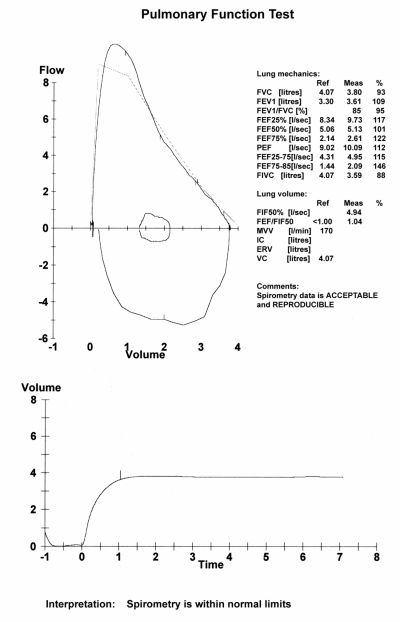
What do the numbers mean?

FEV₁ (Forced Expiratory Volume in 1 Second)

Measures how much air you can blow out in the first second.


Think of it as:

"How quickly your lungs can empty."


Lower values may mean your airways are narrowed.

FVC (Forced Vital Capacity)

Measures the total amount of air you can blow out after taking a full breath in.


Think of it as:

"How much air your lungs can hold."

FEV₁/FVC Ratio

Compares how much air comes out in the first second with the total amount you blow out.


Think of it as:

"How easily air can leave your lungs."


  • Normal ratio: Airways are likely open.
  • Low ratio: Airways may be narrowed or blocked.

What happens after the test?

Your healthcare provider will explain your results and decide whether you need:

  • No further treatment if your lungs are working normally. 
  • An inhaler or changes to your current treatment. 
  • More breathing tests. 
  • A chest X-ray or CT scan if more information is needed. 
  • Advice about quitting smoking, exercise, or pulmonary rehabilitation if appropriate.

A simple way to remember it

Think of your lungs like a balloon:

  • 🎈 Normal: The balloon fills and empties easily. 
  • 🚧 Obstructive: The balloon opening is narrow, so air gets out slowly. 
  • 📦 Restrictive: The balloon can't stretch fully, so it holds less air. 
  • 🔄 Mixed: The balloon doesn't stretch well, and the opening is narrow too. 

This simple comparison can make it easier to understand what your lung function results mean.

Types of Lung Function Tests (Simple Summary)

Spirometry

Bronchodilator (Reversibility) Test

Bronchodilator (Reversibility) Test

What it measures:

Airflow and the amount of air you can breathe out.


 Why it's useful:

Diagnosing and monitoring asthma, COPD and other breathing conditions.

Bronchodilator (Reversibility) Test

Bronchodilator (Reversibility) Test

Bronchodilator (Reversibility) Test

What it measures:

Lung function before and after using an inhaler.


 Why it's useful: 

Determining whether your airways improve with medication, helping diagnose asthma and guide treatment.

Peak Expiratory Flow (PEF)

Bronchodilator (Reversibility) Test

Peak Expiratory Flow (PEF)

What it measures: 

The fastest speed you can blow air out.


 Why it's useful: 

Monitoring asthma and detecting changes in breathing over time.

Lung Volumes

Fractional Exhaled Nitric Oxide (FeNO)

Peak Expiratory Flow (PEF)

What it measures:

The total amount of air your lungs can hold, including the air left after breathing out.


 Why it's useful:

Diagnosing restrictive lung diseases and identifying air trapping, such as in COPD.

Gas Transfer Test (DLCO)

Fractional Exhaled Nitric Oxide (FeNO)

Fractional Exhaled Nitric Oxide (FeNO)

What it measures:

How well oxygen moves from your lungs into your bloodstream.


 Why it's useful:

Identifying conditions affecting the lung tissue or blood vessels, such as emphysema, pulmonary fibrosis or pulmonary hypertension.

Fractional Exhaled Nitric Oxide (FeNO)

Fractional Exhaled Nitric Oxide (FeNO)

Fractional Exhaled Nitric Oxide (FeNO)

What it measures: 

The level of inflammation in your airways.


 Why it's useful:

Diagnosing and monitoring asthma, particularly inflammation that responds to inhaled corticosteroids.

Mannitol Challenge Test

Mannitol Challenge Test

Mannitol Challenge Test

What it measures:

How sensitive (reactive) your airways are by assessing changes in breathing after inhaling increasing doses of mannitol.


 Why it's useful:

Diagnosing asthma when routine lung function tests are normal but symptoms suggest asthma.

Exercise Testing

Mannitol Challenge Test

Mannitol Challenge Test

What it measures:

How your lungs and heart respond during physical activity.


 Why it's useful:

Investigating breathlessness during exercise and assessing fitness or the severity of lung disease.

Key Message for Patients

No single test tells the whole story. 


Your healthcare provider may use one or several lung function tests to understand:


  • How well your lungs are working 
  • Why you are experiencing breathing problems 
  • Whether your treatment is working 
  • How your lung condition changes over time

What to do next...

Book OnlineDownload ReferralSend us an enquiry

Copyright © 2026 stgsc.com.au - All Rights Reserved.